Construction Site Generator Rental in the UAE: A Contractor's Guide Before You Sign
A contractor's practical guide before signing a construction-site generator rental contract in the UAE: sizing by calculation, daily vs monthly vs yearly rental, the questions that protect you in the contract, common site faults, and a full preparation checklist.
Short answer: Construction site generator rental starts with calculating the actual load of each phase in kilowatts (kW), then converting it to KVA. Choose the rental period, daily, monthly or yearly, based on your project length. Before you sign, get these in the contract: replacement if the unit breaks down, fuel and cables, and the operator. This article explains each step in detail so you know what to ask for and what to check.
Why is a site generator different from a normal rental?
A construction site is not like a place where you run a generator for one or two days. The load changes from phase to phase. The load at the start of a project is different from the load during finishing. When you look for construction site generator rental UAE, think about this change from day one.
A site has dust, and in summer the heat puts more pressure on the air filter and the cooling system. If the generator stops, the workers and equipment stop, and the whole project gets delayed. That is why the contract terms must be clear from the beginning, not after a breakdown happens. A construction site is also a harsh place for any machine: dust comes in with the cooling air, loads change from one hour to the next, and running stretches for long hours. A generator that suits a one-day event does not necessarily suit a site that runs non-stop — in practice, a site rental contract is written around three words: the load, the period, and the replacement.
How do you size the right generator for the site?
The first step in any construction site generator rental is calculation, not guessing. Write a list of all equipment and loads for each phase, and add up the power in kilowatts (kW). Then convert it to KVA by dividing by about 0.8, because 0.8 is the power factor commonly used (kW ÷ 0.8 ≈ KVA).
Quick conversion table (load in kW ÷ 0.8):
| Load (kW) | Approx. size (KVA) |
|---|---|
| 10 | 12.5 |
| 20 | 25 |
| 40 | 50 |
| 60 | 75 |
| 80 | 100 |
| 120 | 150 |
| 160 | 200 |
Note: this table's figures are from this guide, for illustration — confirm actual values with the supplier before deciding.
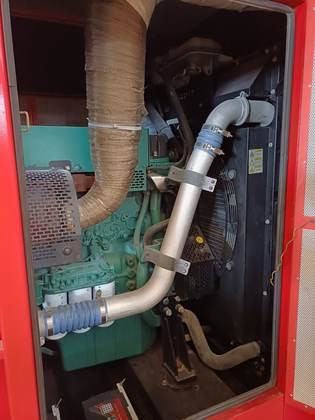
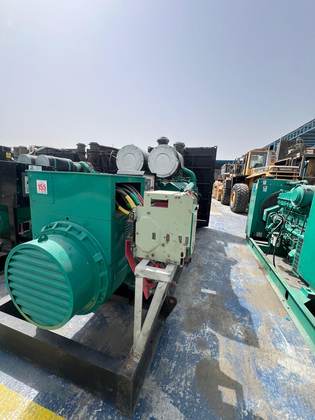
Worked example: a contractor added up the loads of the foundation phase and got a total of 64 kW. The conversion: 64 ÷ 0.8 = 80 KVA. That figure is before the starting-current allowance, so the practical choice is the next available size up, not exactly 80. And when the works move to a lighter phase, the size is reviewed again instead of carrying on with a large unit on a light load. Examples of construction-site class units in our stock: a 625 KVA generator and a 1500 KVA generator — their photos and details appear below the article.
Do not forget the motor starting margin. When motors start, they draw a current that is much higher than their normal running current. If you do not allow for this, the generator may struggle or shut down when the equipment starts. This is one of the most important things to check when choosing a generator for a construction site.
Also note that a large generator running a light, steady load causes carbon build-up called wet stacking, which reduces performance over time. The best approach is to match the size to the actual phase. If the phase changes, review the size. For a quick estimate before you talk to any supplier, try the generator size calculator.
Daily, monthly or yearly?
Daily, monthly and yearly rental are all common options in the market. The right choice depends on how long you actually need the generator. If the work is short or temporary within the project, daily rental is usually more suitable. If the phase is continuous, monthly rental is often a better fit. If the project is long or the need lasts all year, yearly rental is worth considering.
Do not compare prices here. If you want to know the cost, read our article on generator rental cost in Sharjah, or contact us on WhatsApp.
| Period | Usually suits | Check in the contract |
|---|---|---|
| Daily | Short or temporary work within the project | Included running hours and who fills the diesel |
| Monthly | Continuous construction phases | Replacement if it breaks down, and routine maintenance |
| Yearly | Long projects or continuous need | Changing the size as the phase changes, and a resident operator |
What should you ask the supplier before you sign?
Before you sign any construction site generator rental contract, ask the supplier these questions:
- Is there an immediate replacement if the unit breaks down?
- Is the unit silent if there are homes near the site?
- Do you supply an ATS panel or a synchronizing panel?
- Who provides the diesel tank and the cables?
- Is there a resident operator?
- Who pays for maintenance?
And why these questions in particular? Because each one closes the door on a known problem: replacement closes the door on stopped work, the silent unit on complaints from nearby housing, the ATS and synchronising panels on wrong connections, fuel and cables on hidden costs that surface mid-project, and the operator and maintenance on the "not my responsibility" answer when the generator stops.
Get every answer in writing in the contract. Do not rely on verbal promises. If you want to know the rental details for your site, contact us and ask.
You can also check the available generators to see the sizes we offer before you get in touch.
Common site faults and what to do
Many faults have clear signs you can notice yourself, and the most visible one is the color of the smoke. The table below helps you find the likely cause, the first action to take, and when to call a technician or the supplier. And before the table, one quick rule: smoke colour is the engine's first message — black is usually an air-and-fuel story, white is unburnt fuel or water in it, and blue is oil burning where it should not. And if there is no smoke at all and the generator will not crank, start with the battery: it is the most common cause of a no-start.
| Symptom | Likely cause | First action | When to call a technician or supplier |
|---|---|---|---|
| Generator will not turn over at all | Weak battery (lead sulphation), the most common cause of no start | Check the battery and terminals | If it repeats after charging or replacing the battery |
| Cuts out or stops after being idle for a long time | Air in the fuel system | Prevent it by running a weekly test | Bleeding air should be done by a technician |
| Black smoke | Wrong air-fuel mixture or a blocked air filter (site dust) | Check the air filter | If it continues after cleaning or replacement |
| White smoke | Unburnt fuel or water in the diesel | Check the diesel source and the tank | If it does not go away after protection measures |
| Blue smoke | Oil burning or worn piston rings | Stop the generator | Contact immediately |
| Runs but no power output | AVR (voltage regulator), exciter, or brushes | Do not open the panel yourself | Generator electrical technician |
| High temperature or shutdown due to heat | Coolant, radiator, or fan | Check coolant level and clean dust off the radiator | If it repeats |
| Shuts down due to oil pressure | Low oil pressure | Check oil level and do not keep restarting | Contact before restarting |
| Diesel leak | Cracked hoses or valves | Stop the generator and remove ignition sources | Contact immediately |
| Carbon build-up and weak performance under constant light load | Wet stacking caused by chronic light load | Review whether the size matches the phase load | Discuss resizing with the supplier |
If the repair is internal, it must be done by a technician. If the generator is rented, contact the supplier first.
Preparation checklist before the generator arrives on site
Before the generator arrives on site, prepare the following:
- ☐ List of equipment and loads for each phase of the project
- ☐ Size in KVA after conversion, with a margin for motor starting current
- ☐ A level, ventilated spot for the generator, away from excavations and equipment movement
- ☐ Diesel tank: who provides it and who fills it
- ☐ Cables: required length and who provides them
- ☐ Silent unit if the site is near homes
- ☐ ATS panel if there is a second power source, and a synchronizing panel if you will run more than one generator
- ☐ Written clause on replacement if it breaks down
- ☐ Operator decision: resident or not
- ☐ Emergency contact number from the supplier
Frequently asked questions
How many KVA do I need for a construction site?
There is no fixed number. Add up the loads of the phase in kW, divide by about 0.8, and add a margin for motor starting. We supply sizes from 15 to 1500 KVA.
Daily or monthly generator rental — which is cheaper?
It depends on how long you need it. Monthly rental usually suits continuous phases, and daily rental suits short jobs. For cost, read our article on rental costs or contact us on WhatsApp.
Who pays if a rented generator breaks down on site?
The contract decides this. Ask about replacement if it breaks down and who is responsible for maintenance, and get the answers in writing.
Do I need an ATS panel on a construction site?
You only need one if there is a second power source you want to switch between. An ATS panel transfers the load automatically, and it has an interlock that prevents the two sources from being connected together.
Why is my generator blowing black smoke on site?
The usual cause is a wrong air-fuel mixture or a blocked air filter. Site dust makes the filter block faster. Start by checking the filter.
Halab Al Shahba is located in Industrial Area 3 in Sharjah. We sell and rent generators from 15 to 1500 KVA, and we provide generator rental for sites and events. If you are starting a construction site generator rental UAE project, send us your load list and project duration on WhatsApp.
Photos of the units mentioned here are below the article — actual photos from Halab Al Shahba stock in Industrial Area 3, Sharjah. (Last reviewed: October 2026.)
Generators mentioned in this article