
Import a Generator or Buy Locally in the UAE? Cost, Customs and Warranty
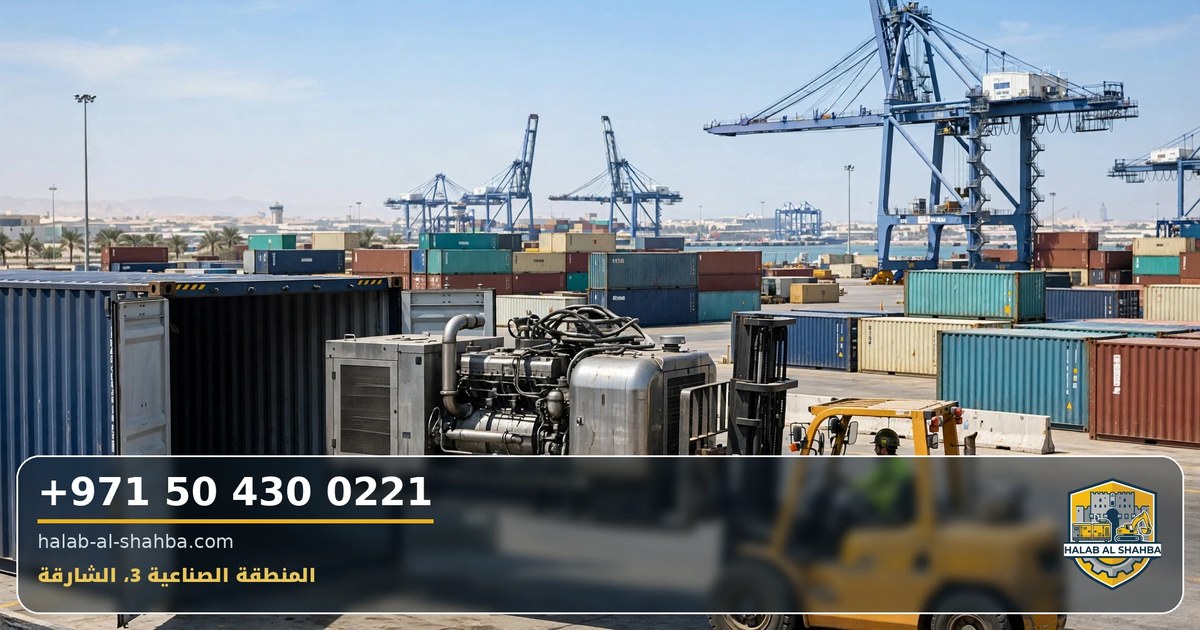
Buying locally is often cheaper and safer once you add the true import costs: customs, shipping, inspection and warranty. A line-by-line comparison with a decision checklist.
Short answer: if you need the generator quickly, with local warranty and an inspection before you pay, buying locally is usually cheaper and safer overall. Importing can save on the initial purchase price, but customs, shipping, inspection and warranty add cost and risk. This guide compares both options line by line so you can make a calculated decision.
Why the purchase price alone does not decide it
A generator abroad can look cheaper at first glance, especially in large manufacturing markets. But that price is an "ex-works or port" price — not what you will actually pay until the unit is running at your site. Between the two figures sit ocean freight, insurance, customs, clearance, inland transport, inspection, installation and commissioning — each adding money, time and risk. Local buying, by contrast, shows its price upfront and usually includes inspection, testing and warranty. So the right comparison is not between two prices, but between the "total cost at the moment of operation" and the risk level of each route.
Line-by-line comparison: importing vs buying locally
| Item | Importing | Buying locally |
|---|---|---|
| Initial purchase price | Usually lower, especially for common models and large ratings | Looks higher, but is close to the final price |
| Customs and tax | Customs duty commonly around 5% approximately, plus 5% VAT approximately — verify current rates before shipping | Usually included in the final sale price |
| Shipping and insurance | On you: ocean freight + insurance + port handling fees | Usually on the seller, within the price or agreed delivery |
| Clearance and inland transport | Customs broker + warehousing + transport to your site, all at your cost | Usually ready in the yard; transport is simpler to arrange |
| Delivery time | Weeks to months approximately, depending on origin and shipping line | Immediate or within days for ready stock |
| Inspection before payment | Nearly impossible; you buy from photos, specs and reports | Fully available: inspect, run and load-test |
| Warranty | International; slow to execute and may not cover local labour | Local and direct from the seller, with a nearby workshop and parts |
| Spare parts and service | Depends on dealer and model availability inside the UAE | Usually faster, thanks to local stock and workshops |
| Spec mismatch risk | Different voltage or frequency; undocumented running hours on used units | An original data plate you can check with your own eyes |
How to calculate the true cost of importing
To compare fairly, stack these items in order before the first invoice tempts you:
- Purchase price plus any broker or platform commissions.
- Ocean freight from the origin port to UAE ports, plus shipment insurance.
- Customs duty (commonly around 5% approximately on the value) and 5% VAT approximately — rates can change, so confirm them with your customs broker or the official authorities before shipping. VAT-registered businesses handle input VAT under the applicable rules, so ask your accountant.
- Clearance, warehousing and handling fees, plus any demurrage.
- Inland transport from the port to your site, plus crane or forklift on installation day.
- Post-arrival inspection: electrical and mechanical checks and a load test, plus any surprise repairs.
- Installation and commissioning: cables, an ATS panel if needed, a base and ventilation.
Once you add these up, the gap between the two prices shrinks a lot — and sometimes reverses, especially for small and mid ratings and for used generators.
When does importing actually make sense?
Importing genuinely wins in these cases:
- You are buying a fleet or several units in one shipment, so freight and clearance costs spread across more than one generator.
- You need a rare specification or a rating that is not available locally at the time.
- There is no time pressure: your project can wait weeks or months for the unit to arrive.
- You have import experience or trusted freight and clearance agents, and you can arrange an independent inspection in the origin country before shipping.
Even then, importing remains a risk-management decision before it is a saving decision.
When does buying locally win?
- You need a single unit for a project, a villa or an event, and time will not wait.
- Inspection and a real load test are non-negotiable for you — especially with used units.
- A direct local warranty matters more to you than a theoretical price gap.
- You want fast spare parts and service if anything fails in early operation.
In these cases, browse the generators actually available in the yard and compare them face-to-face with the total import cost — the picture becomes far clearer than comparing headline invoices.
Checklist before you decide
If you plan to import:
- Confirm the HS code and the current duty and tax rates in writing from your broker.
- Ask for a "delivered to your site" quote covering freight, insurance, clearance and transport — not a port price only.
- Arrange an independent inspection at origin: data plate, running hours, a filmed load test.
- Confirm voltage and frequency match the UAE grid (typically 400/230V – 50Hz) before paying.
- Ask about the warranty: who executes it locally, and does it cover labour and parts?
- Build a delay margin into the arrival time, and plan temporary power if your project is live.
If you plan to buy locally:
- Inspect the unit yourself: original data plate, running hours, oil and fluid condition.
- Test it under a real load, not just a no-load run.
- Get the warranty and its terms in writing, and ask about parts availability for your model.
- Confirm what the price includes: delivery, installation, cables, commissioning test.
At Halab Al Shahba: see it and test it before you pay
We are Halab Al Shahba Trucks & Heavy Equipment Trading, in Industrial Area 3, Sharjah. We stock new and inspected used generators with original data plates, in ratings from roughly 15 to 1500 KVA, and every unit can be inspected, started and load-tested before you buy — exactly the step importing cannot give you. See the generators currently available, or contact us with your required rating and use case, and we will compare local vs import costs with you in honest approximate numbers.
FAQ
Roughly how much customs duty applies to generators in the UAE?
Commonly around 5% customs duty approximately, plus 5% VAT approximately on the import value. Rates and classifications can change depending on the generator type and its tariff code, so confirm the current figures with your customs broker or the official authorities before you ship — do not base your decision on a number you heard second-hand.
Is buying locally always more expensive?
No. The initial purchase price abroad may be lower, but after shipping, customs, clearance, inspection and spec risk, the total cost usually converges — and local sometimes works out cheaper, especially for small and mid ratings and for used units you cannot inspect overseas.
Roughly how long does importing a generator take?
Approximately from several weeks to several months, depending on the origin country, vessel availability and clearance speed. Any delay at the port or in paperwork lands directly on your project schedule, while ready local stock usually reaches you within days.
What happens if the imported generator arrives faulty or off-spec?
Your options are far narrower than with a local purchase: claiming against an overseas seller or the insurer takes time and may not cover the full loss, and returning the unit is practically near-impossible. That is the price of having no inspection before payment, and it should be priced into your decision from the start.
Is an international warranty enough, or do you need a local one?
An international warranty may cover the part in theory, but executing it is usually slow and it may not cover local workshop labour or downtime. A local warranty from a seller present in the market, with a nearby workshop, saves you time and stoppage — and downtime on a project generator is a cost in itself.